Profit per trip is the freight you actually receive for a trip, minus every cost of that trip. That means diesel, toll, driver allowance, loading and unloading, commission, a fair share of fixed costs like EMI, insurance, permits, maintenance and tyres, and the cost of the return run if the truck comes back empty. Most transport owners know their monthly profit. Very few know which trips made money and which ones lost it.
Why monthly profit hides the real picture
At the end of the month, the bank balance looks fine. The trucks were busy. So where is the problem?
The problem is that a good month can hide bad trips. One lane may pay well. Another lane may lose money on every trip, because the truck comes back empty or waits two days to load. When you only look at the monthly total, the good trips pay for the bad ones, and nobody notices.
When you know the profit of each trip, you can do three things:
- Raise rates on lanes that lose money, or stop taking them.
- Plan return loads before the truck leaves.
- Spot drivers or vehicles whose diesel or expenses are always higher than the rest.
The simple formula
You do not need complex accounting to start. Use this:
Profit per trip = Freight received − Trip costs − Share of fixed costs − Cost of empty return (if any)
| Part | What goes in it |
|---|---|
| Freight received | The amount the customer will pay for this trip, after any deduction for shortage or damage. |
| Trip costs | Diesel, toll, driver allowance (bhatta), loading and unloading, broker commission, parking, police and RTO receipts. |
| Share of fixed costs | EMI, insurance, permit, fitness and tax, spread over the trips the truck does in a month. Add a share of maintenance and tyres too. |
| Empty return | Diesel, toll and driver cost of coming back with no load. |
A worked example
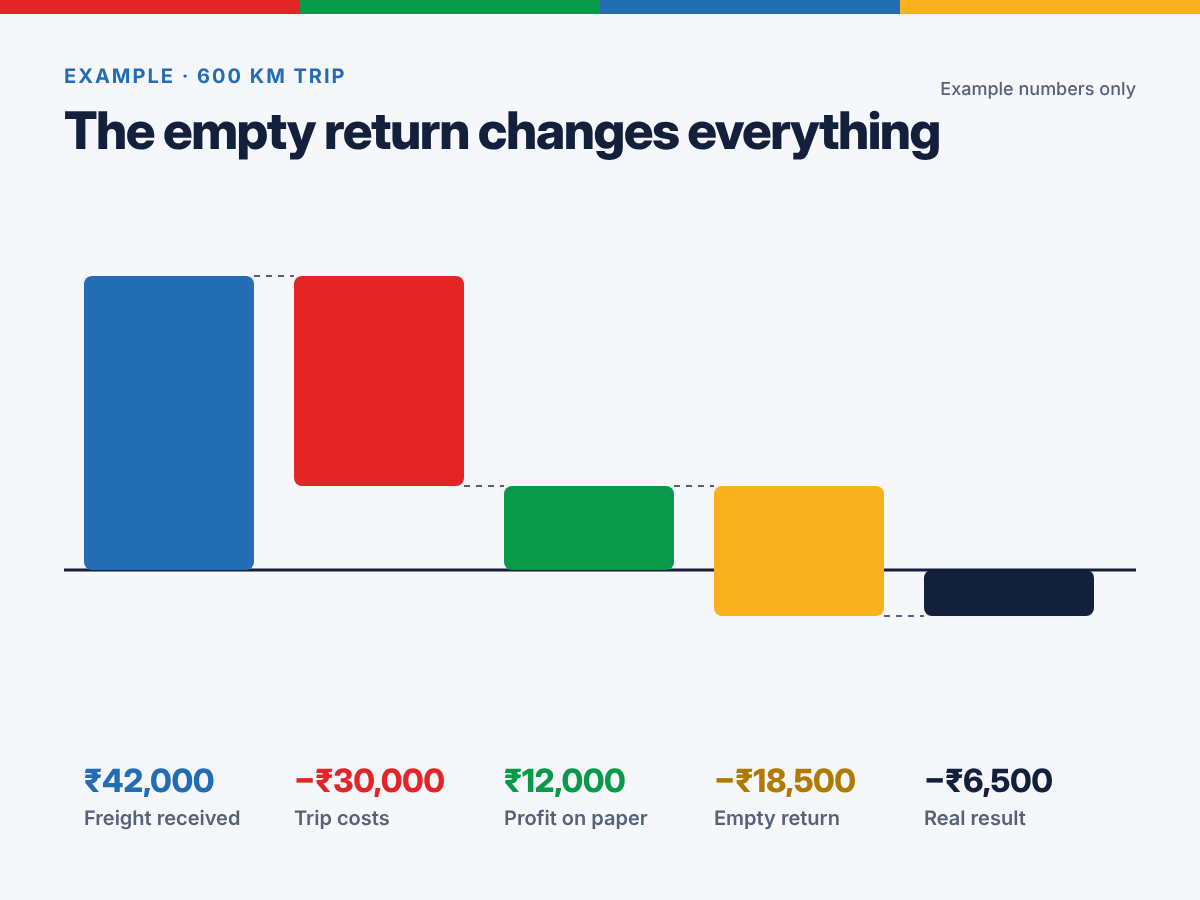
Here is a simple example for a 600 km trip. These are example numbers only, to show the method. Your rates and costs will be different.
| Item | Amount (₹) |
|---|---|
| Freight received | 42,000 |
| Diesel | 14,000 |
| Toll | 3,500 |
| Driver allowance | 2,500 |
| Loading and unloading | 1,200 |
| Broker commission | 1,000 |
| Share of EMI, insurance and permit | 5,000 |
| Share of maintenance and tyres | 2,800 |
| Total cost of the trip | 30,000 |
| Profit on the trip | 12,000 |
₹12,000 looks good. But what if the truck comes back the same 600 km with no load?
| Empty return | Amount (₹) |
|---|---|
| Diesel on the empty return | 12,500 |
| Toll on the return | 3,500 |
| Driver allowance on the return | 2,500 |
| Cost of the empty return | 18,500 |
| Real result of the round trip | Loss of 6,500 |
The same trip that looked like ₹12,000 profit is a ₹6,500 loss. This is why the return load matters as much as the first load, and why it should be counted in the trip, not hidden in the month.
6 costs that transport owners miss most often
1. Cash advances written down late
The driver takes cash for diesel or expenses. The amount is noted in a diary or on WhatsApp and reaches the office days later, or never. Record every advance against the trip on the same day, with a photo of the slip.
2. Detention and waiting time
The truck waits a day at the factory to load, or two days at the port. That time has a cost. If your contract allows detention charges, add the hours to the trip so they are billed. If it does not, at least count them, so you know which customers cost you time.
3. Empty return runs
As the example shows, an empty return can wipe out the profit of the first leg. Count it in the trip. Then track your empty kilometres for each vehicle every month.
4. Late freight bills
When trip details reach accounts late, the invoice goes late, and payment comes even later. Late payment is not a cost on paper, but it ties up your money and adds interest if you run on credit. Raise the bill as soon as you have the proof of delivery.
5. Missed service, tyre and document dates
A missed service leads to a breakdown. An expired permit or fitness paper keeps the truck standing. Every idle day still has an EMI. Keep due dates by date and by kilometre, with an alert before each one.
6. Shortage, damage and deductions
When the customer deducts money for shortage or damage, the freight you receive is lower than the freight you quoted. Record the deduction on the trip, not only in the customer's ledger.
What to record for every trip
If you record these points for each trip, profit per trip and per vehicle becomes easy to see:
- Vehicle number, driver and helper
- Customer, lane (from and to) and agreed rate
- LR or consignment note number
- Diesel filled (litres and amount) and every cash advance
- Toll, loading, unloading, commission and other expenses, with photos of slips
- Start and end kilometre reading
- Loading and unloading dates, and detention hours
- Proof of delivery date, invoice date and payment date
- Any shortage or damage deduction
- Return load, or empty return
You can start this in a spreadsheet. The trouble starts when you have many trucks, many drivers and many people entering data. That is when a proper trip system helps.
How transport businesses track this on Zoho
Fleet management on Zoho works by giving each part of the business its own connected app:
- Zoho CRM for customers, enquiries, rate quotes and bookings.
- Zoho Creator for the trip app: vehicles, drivers, trips, diesel, advances, expenses, maintenance and documents with expiry alerts. Drivers can enter data and photos from their phone.
- Zoho Books for freight invoices with tax, payments received and vendor bills.
- Zoho Analytics (optional) for dashboards: profit per trip, per vehicle and per lane, empty kilometres, diesel average and outstanding payments.
Because these apps share data, a booking becomes a trip, the trip becomes a settlement, and the settlement becomes an invoice, without typing the same details again.
We build this around how your fleet already works: your trip sheet, your rate rules and your settlement format. You do not have to change your business to fit the software. See the full flow on our Zoho fleet management page.
Frequently asked questions
How do you calculate profit per trip in a transport business?
Take the freight you will actually receive for the trip. Subtract every cost of that trip: diesel, toll, driver allowance, loading and unloading, commission, and a fair share of fixed costs like EMI, insurance, permits, maintenance and tyres. If the truck comes back empty, add the cost of the return run too. What is left is the real profit per trip.
Why is my transport business busy but not profitable?
Usually because costs are counted for the month, not for each trip. Empty returns, cash advances written down late, detention hours that are never billed and late freight bills make some trips lose money, while the monthly total still looks fine.
Can Zoho be used for fleet and trip management?
Yes. Transport businesses use Zoho CRM for customers, rate quotes and bookings, a Zoho Creator app for vehicles, drivers, trips, fuel, expenses and documents, and Zoho Books for freight invoices and payments. Zoho Analytics can show profit per trip, per vehicle and per lane.
What should I track for every trip?
Track the vehicle, driver, customer, lane, freight amount, diesel, advances, toll, loading and unloading, detention hours, proof of delivery date, invoice date and payment date. With these, profit per trip and per vehicle becomes easy to see.