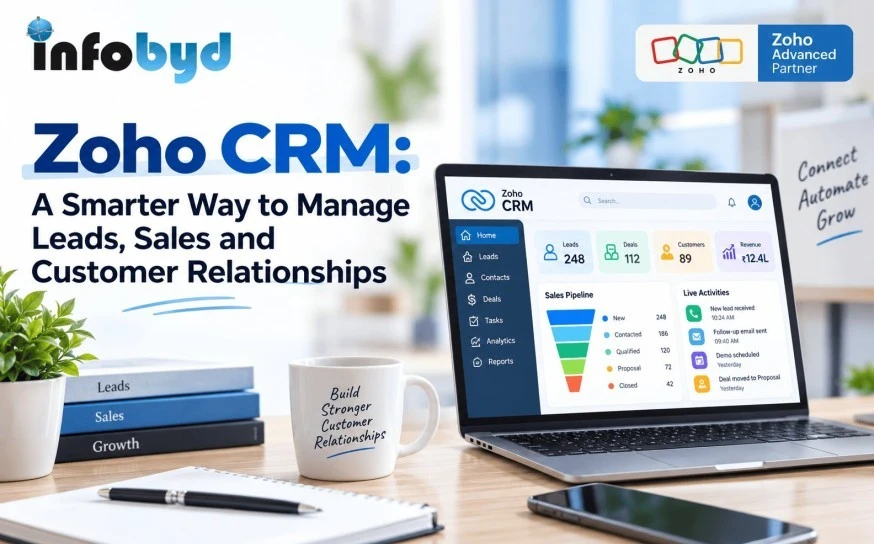
Zoho CRM: A Smarter Way to Manage Leads, Sales and Customer Relationships
 Infobyd
Managing sales becomes difficult when customer information is spread across spreadsheets, emails, WhatsApp conversations, and different tools. Sales teams may have plenty of leads, but without a clear system, it can become difficult to know which prospects need attention, where a deal stands, or when to follow up.
This is where a customer relationship management platform can make a real difference.
Zoho CRM provides businesses with a centralized platform to organize leads, manage sales activities, automate routine tasks, and maintain better customer relationships. Instead of depending on scattered information, teams can bring important sales data into one structured system.
Why Do Businesses Need a CRM?
As a business grows, managing customers manually becomes increasingly challenging.
A small team may initially manage leads through Excel sheets or email. But as the number of enquiries increases, problems can appear quickly. Duplicate records, missed follow-ups, incomplete customer information, and unclear sales responsibilities can affect the overall sales process.
A CRM helps solve these problems by giving sales teams a single place to manage customer information.
It can help businesses:
- Store customer and prospect information
- Track enquiries and leads
- Monitor sales opportunities
- Schedule follow-ups
- Manage sales activities
- Understand the progress of deals
- Improve communication between team members
The goal isn't simply to store customer information. A good CRM should help salespeople understand what needs to happen next.
How Zoho CRM Helps Manage Leads
Lead management is one of the most important parts of the sales process.
Every enquiry represents a potential opportunity, but not every lead is ready to make a purchase. Some may require additional information, while others may need several follow-ups before making a decision.
With a structured CRM system, businesses can record important details about prospects and follow their journey from the initial enquiry to the final sale.
For example, a sales representative can see whether a lead is new, being followed up, qualified, or converted into a customer.
This visibility helps teams spend their time more effectively instead of manually searching through different files and conversations.
Keep Your Sales Pipeline Organized
A sales pipeline gives businesses a clear view of their current opportunities.
Instead of asking sales representatives for individual updates, managers can review the status of deals from a centralized dashboard.
A typical pipeline may include stages such as:
New Lead → Qualified → Proposal → Negotiation → Closed
The exact stages can vary depending on the business.
Having this structure makes it easier to identify opportunities that are moving forward and deals that may require additional attention.
It can also help managers understand the overall health of their sales pipeline and make more informed decisions.
Automate Repetitive Sales Activities
Sales teams spend a significant amount of time performing repetitive tasks.
Sending follow-up reminders, updating records, assigning leads, and performing routine administrative work can take valuable time away from customer conversations.
Automation can reduce some of this manual effort.
For example, businesses can create workflows that trigger specific actions when certain conditions are met. A new lead could be assigned to the appropriate salesperson, a reminder could be generated for a follow-up, or an internal notification could be sent when a deal reaches a particular stage.
Automation doesn't replace the salesperson. Instead, it helps the team spend less time on repetitive administration and more time building relationships and closing opportunities.
Build Better Customer Relationships
Sales is not only about converting leads. Long-term customer relationships are equally important.
When customer information is properly organized, sales teams can have more informed conversations. They can understand previous interactions, requirements, enquiries, and other relevant details without repeatedly asking customers for the same information.
This creates a smoother experience for both the customer and the sales team.
A centralized customer record can also make collaboration easier when multiple employees interact with the same account.
Get Better Visibility Into Sales Performance
Data can help businesses understand what's happening inside their sales process.
Instead of relying entirely on assumptions, managers can review reports and dashboards to understand trends such as:
- Number of incoming leads
- Conversion rates
- Sales pipeline value
- Deal stages
- Sales activities
- Team performance
- Follow-up activity
These insights can help identify areas where the sales process may need improvement.
For example, if a large number of leads are entering the pipeline but very few are moving to the proposal stage, the business may want to examine its qualification or follow-up process.
Who Can Benefit From Zoho CRM?
A CRM can be useful for businesses across different industries and sizes.
It can support teams working in:
- IT and software services
- Real estate
- Education and training
- Consulting
- Manufacturing
- Healthcare
- Financial services
- E-commerce
- Professional services
The specific requirements will vary from one organization to another. A growing business may need basic lead and contact management, while a larger organization may require more advanced automation, reporting, integrations, and customization.
Why Choosing the Right CRM Partner Matters
Implementing CRM software is not simply about creating an account and adding contacts.
Businesses need to think about their existing sales process, data structure, user roles, workflows, integrations, reporting requirements, and long-term goals.
This is where working with an experienced implementation partner can be helpful.
A partner can help businesses understand their requirements, configure the platform accordingly, migrate relevant data, create workflows, train users, and provide ongoing support.
For organizations considering Zoho solutions, Infobyd provides Zoho-related consulting and implementation services to help businesses build solutions around their operational requirements.
Final Thoughts
A well-organized sales process can make it easier for businesses to manage opportunities, respond to customers, and maintain consistent follow-ups. The value of a CRM is not simply in having another software tool, but in creating a connected sales process where customer information, activities, opportunities, and follow-ups are easier to manage.
For businesses that are still relying on spreadsheets, emails, and disconnected systems, moving toward a centralized CRM can be an important step toward a more structured and efficient sales operation.
If you are looking for a CRM solution that can help organize leads, improve sales visibility, automate repetitive activities, and strengthen customer relationships, Zoho CRM can be a practical option to explore.
Take Your Business Operations to the Next Level
At Infobyd, we help businesses make better use of Zoho solutions through consulting, implementation, customization, integration, and automation services. As a Zoho Advanced Partner, our team focuses on understanding your business processes and creating solutions around your specific requirements.
From CRM setup and data migration to workflow automation and business integrations, Infobyd helps businesses build more connected and efficient processes.
Whether you are adopting a CRM for the first time or improving your existing setup, the right technology and implementation approach can make your sales operations more organized and scalable.
Looking to improve the way your business manages sales and customer relationships?
Explore Infobyd to discover Zoho solutions and services designed around your business needs.