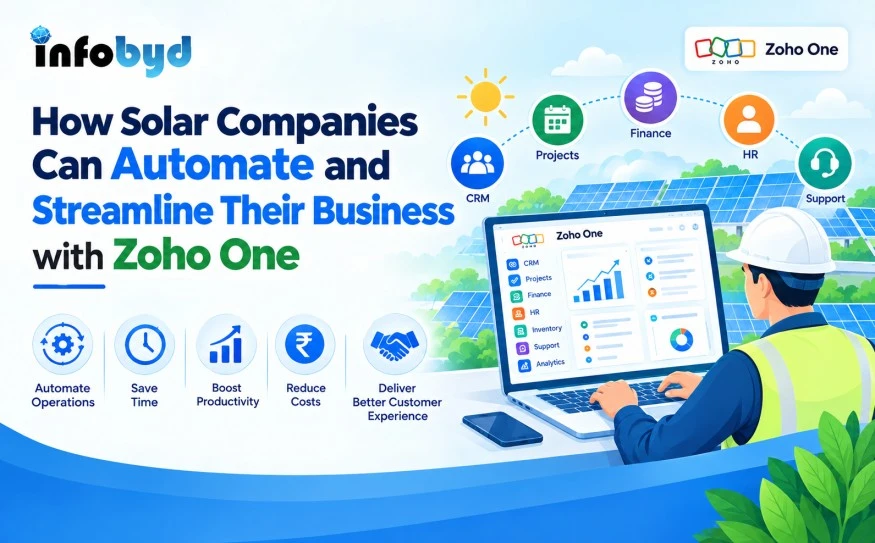
How Solar Companies Can Automate and Streamline Their Business with Zoho One
 Infobyd
Solar businesses manage much more than leads and sales. From enquiries and site surveys to quotations, inventory, installation, payments, customer support, and after-sales service, multiple teams need to work together to keep a project moving.
When these processes are managed through spreadsheets, emails, WhatsApp messages, and disconnected software, it becomes difficult to track leads, follow up with customers, manage projects, and maintain accurate information.
This is where Zoho One for solar businesses can make a difference.
Zoho One is a business software suite that brings together applications for CRM, sales, finance, inventory, project management, communication, marketing, customer support, and more. With the right implementation, solar companies can connect these functions into a more streamlined business workflow.
Why Solar Companies Need Business Automation
A typical solar company may have a workflow like:
Lead → Qualification → Site Survey → Proposal → Follow-up → Order → Inventory → Installation → Payment → Support
Every stage involves different people and information.
For example, the sales team may collect customer details in Zoho CRM, while the site survey team uses a spreadsheet. The quotation may be created separately, inventory is tracked somewhere else, and installation updates are shared through WhatsApp.
This creates several common problems:
- Leads are not followed up on time
- Customer information is duplicated
- Sales teams lack visibility into project status
- Who will use the application?
- Site survey information is difficult to track
- Inventory updates are delayed
- Installation teams rely on manual communication
- Management lacks real-time reports
- Customers have to repeatedly provide the same information
Zoho One can help connect these processes and reduce unnecessary manual work.
1. Centralize Solar Leads with Zoho CRM
The first step is creating a centralized system for managing leads. With Zoho CRM, solar companies can capture leads from websites, campaigns, advertisements, forms, and other sources into one system.
Sales teams can track:
- Customer details
- Lead source
- Solar requirements
- Location
- System size
- Budget
- Sales stage
- Follow-up activities
- Site survey status
- Quotation status
Instead of asking salespeople to maintain individual spreadsheets, management can get a real-time view of the sales pipeline.
2. Streamline Site Survey Management
Site surveys are an important part of the solar sales process.
A survey may require information about:
- Property details
- Roof type
- Roof condition
- Electricity usage
- Existing electrical infrastructure
- Available installation area
- Customer requirements
- Photos and documents
Instead of managing this information through paper forms or disconnected spreadsheets, solar companies can create structured digital forms and workflows. The survey information can then be connected with the customer's CRM record.
This gives the sales and project teams access to the same information and reduces repeated data entry.
3. Create and Track Solar Quotations
After a site survey, the sales team typically needs to prepare a proposal or quotation. With Zoho's business applications, companies can streamline the process from opportunity to quotation and order.
Sales teams can maintain standardized product and pricing information while generating quotations based on customer requirements.
Automation can also help with:
- Quote creation
- Approval workflows
- Customer notifications
- Follow-up reminders
- Quote status tracking
Management can see which proposals have been sent, which are pending, and which have converted into orders.
Want to see how this works in practice?
Join our live webinar to discover how Zoho One can help solar companies automate sales, operations, and customer management.
4. Manage Inventory and Solar Equipment
Solar installations involve multiple products and components, including:
- Solar panels
- Inverters
- Batteries
- Mounting structures
- Cables
- Cables
- Connectors
- Electrical components
Inventory problems can directly affect installation timelines. Using applications such as Zoho Inventory, businesses can improve visibility into stock levels, sales orders, purchases, warehouses, and product movement.
This can help teams answer questions such as:
Do we have the required equipment for this installation?
Which products are currently available?
Which products are currently available?
Where is the inventory located?
Connecting inventory information with the broader sales and operational workflow can reduce manual coordination between sales, purchasing, and installation teams.
5. Connect Finance and Payments
Sales and installation teams need visibility into payment status. Using Zoho's finance applications, businesses can manage areas such as:
- Invoices
- Payments
- Expenses
- Customer balances
- Financial reporting
Connecting finance with sales and customer information can make it easier to understand the financial status of each customer or project.
For example, the business can track whether an installation has been completed and whether the required payment has been received.
6. Get a Complete View of the Business
One of the biggest advantages of using Zoho One is the ability to connect different business functions. Management can create reports and dashboards covering areas such as:
- Lead generation
- Sales pipeline
- Conversion rates
- Revenue
- Pending quotations
- Installation projects
- Inventory
- Payments
- Customer support
This gives decision-makers better visibility into what is happening across the business.
Instead of waiting for different teams to prepare separate spreadsheets, management can work with more centralized business information.
Why Work with a Zoho Implementation Partner?
Zoho One provides a large collection of applications, but simply purchasing Zoho One does not automatically create an efficient business system.
Solar companies first need to understand their existing processes and then determine:
- Which Zoho applications are required
- What information needs to be connected
- Which tasks should be automated
- What workflows should be created
- What integrations are needed
- How data should be structured
- Which reports management needs
A Zoho implementation partner can help design and configure the system around the company's actual business processes.
At Infobyd, we help businesses implement and optimize Zoho solutions by understanding their workflows, configuring applications, creating automation, connecting business processes, and helping teams adopt the system effectively.
Final Thoughts
Solar companies are managing increasingly complex sales and operational processes. When information is spread across spreadsheets, emails, messaging applications, and disconnected tools, it becomes difficult to scale efficiently.
Zoho One can help solar businesses bring CRM, sales, finance, inventory, project management, marketing, and customer support into a more connected business ecosystem..
The goal is not to automate everything simply for the sake of automation. The goal is to identify repetitive and disconnected processes, improve the flow of information, and give teams the tools they need to work more efficiently.
For solar companies looking to improve lead management, automate follow-ups, streamline site surveys, manage installations, track inventory, and improve customer service, a properly implemented Zoho One system can provide a strong foundation for growth.